Showing posts with label nonfiction. Show all posts

Friday, June 12, 2009

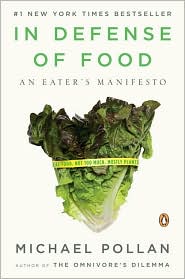
Book Review: In Defense of Food by Michael Pollan

Publisher: Penguin

Publication Date: April 2009

ISBN-13: 978-0143114963

MSRP: $15.00

Format: Mass market paperback

Available from Amazon.com


I enjoy a good conspiracy theory every once in a while. But sometimes you get a book that is disturbing because it isn't a theory, it is actually based in fact. Take everything you have learned about nutrition from the food pyramid to your "recommended daily allowances" and toss it out the window. Because since the 1980's Americans haven't been eating "food." Nope, we have eating "food products" or "food substitutes" and that is an entirely different ballgame.


In Defense of Food: An Eater's Manifesto, is a call to action to defend real food. The book makes a startling point, that as we become increasingly consumed with issues of health, we have become increasingly unhealthy. The problem isn't low-fat, trans-fat, poly-unsaturated fat, or any other evil nutrient, but rather the fact that most of the "food science" that goes into making new food products has no science backing it up. Our great grandparents all lived long and healthy lives with out any of these specially formulated foods. So, it stands to reason that the problem is that Americans have simply stopped eating food.


Pollan systematically goes through the current nutritional advice and pokes holes into each theroy. He also points out numerous food scandals in which we have been told by the FDA or scientist to consume some nutrient over another only to find out that that advice had dire impacts on our health. (Of course, each of these past scandals have been swept under the rug, so this is the first time you will hear about them.) So in the end, what is a girl to do? According to Pollan, we don't need food pyramids, recommended daily allowances or anything else. We just need seven simple words, "Eat Food. Not too much. Mostly plants." Pollan describes these 3 tenants in more detail in the book, but it is basically a lot of common sense. If it has more than 5 ingredients, ingredients you can't pronounce and doesn't resemble the animal or plant is supposed to come from? It probably isn't food. Oh and if someone goes through great pains (a lot of marketing dollars) to convince you that something is health? Chances are it isn't!


This is a good read for anyone and everyone. You see TV ads all the time sponsored by some food lobby and you can't help but believe something is true after it hearing it so many times. And surely, if it wasn't true, they wouldn't let them put false labels on boxes or make false claims, right? Wrong! Most of those claims are considered marketing and don't need to be backed by science or testing. And most of the claims are subjective anyway.


But a really "fun" game to play after reading this book is to go through your home pantry and see how much in it is actually food and how much are engineered food products. It was pretty disturbing and enlightening when I opened up my refrigerator. I would say only about 20% of the "food" in my cabinets could actually be defined as food... Another good book to check out is Skinny Bitch by Roy Freedman and Kim Barnouin. After reading it, you will never want to drink a glass of milk again. I don't care how cool those "got milk" ads are!


xoxo,

Tissie


Read more!

Tuesday, June 2, 2009

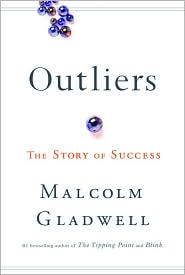
Book Review: Outliers - The Story of Success by Malcolm Gladwell

Book Information
Publisher: Little, Brown and Company (Hachette Book Group)
Publication Date:
ISBN-13:
978-0316017923
MSRP: $27.99
Format: Hardcover
Available from
Amazon, Barnes & Noble, Borders and Powell's


"Why do some people succeed far more than others?"

That is a question we ask ourselves almost everyday. The world is filled with rags to riches stories about individuals who through sheer determination, guts, grit, intelligence and ambition fight the odds to become "successful." In Outliers, Malcolm Gladwell seeks to to understand how people thrive by looking around them. Who are their parents? Where do they live? What is their birthdate? What is their cultural background? Gladwell's findings are shocking and astounding.


Want to know the secret to becoming a world class hockey player in Canada? At first glance, you might think that being an incredible hockey player requires you have an innate talent. But as Gladwell takes you through the rosters of successful hockey teams, you will start to notice an unnerving pattern. All world star hockey players are born in January, February or March. The same applies to successful lawyers in New York City. All of them have the exact same resume and are Jewish.

The reason? The eligibility date for hockey leagues is January 1. Therefore, children born in December are a full 11 months behind in their physical development compared to their teammates born in January. For boys in the middle of puberty 11 months is a huge different in physical strength, height and agility.

As for why all the most successful NYC lawyers are Jewish. Chalk that one up to good old discrimination. Unable to be hired in the prominent WASP firms back in the 1960's they started their own firms and were able to turn them into powerhouses by accepting cases that their WASP counterparts weren't willing to dirty their hands with - hostile company takeovers.

But along with all the "success" stories, Gladwell examines many "failures" as well. He strives to show us that really successful people, or outliers, really aren't outliers after all. They aren't any smarter than the rest of us. They don't possess some innate talent that the rest of us don't have. They weren't "special." All of their stories follow a peculiar and unexpected logic that explains their road to success. In essence, he takes the romance out of the rags to riches story and presents us with the cold hard truth. People who are "successful" were all given an opportunity and had the strength and presence of mind to seize it.

This a book everyone should pick up and read. While it might be too late for us to become as successful as Bill Gates or the Beatles, at the very least we can use our influence to give someone else a chance.

xoxo,
Tissie

Read more!

Thursday, May 14, 2009

Book Review: Freakonomics by Steven D. Levitt

What do school teachers and sumo wrestlers have in common? What about real estate agents and members of the KKK? And the million dollar question - why do drug dealers live with their moms? All the answers to these questions and more can be found in Freakonomics by Steven D. Levitt and Stephen J. Dubner.

Steven Levitt is a rogue economist. As the book explains:

"Many people - including a fair number of his peers--might not recognize Levitt's work as economics at all. But he has merely distilled the so-called dismal science to its most primal aim: explaining how people get what they want. Unlike most academics, he is unafraid of using personal observations and curiosities; he is also unafraid of anecdote and storytelling (but he is afraid of calculus). He is an intuitionist. He sifts through a pile of data to find a story that no one else has found. He figures a way to measure an effect that veteran economists had declared unmeasurable. His abiding interests--though he says he has never trafficked in them himself--are cheating, corruption, and crime."

Levitt poses numerous questions in his book ranging from what makes good parents to what caused the dramatic reduction in crime in the early 1990's. While some of the questions and answers posed make perfect sense, others may leave you with a sorry taste in your mouth. Probably the most controversial aspect of the book is how Levitt attributes the decline in crime in the 1990s to the legalization of abortion. I am kind of sitting on the fence with that one. On one hand, unwanted and neglected children are more likely to turn to a life of crime. At the same time, you can make numbers say anything - which is one of the themes of the book.

Overall, Freakonomics was a very interesting read. I am not usually big on nonfiction. Too dry for my tastes. But, the book kept me interested and engaged from beginning to end. And now I know why drug dealers live with their mothers, so that in itself was worth reading the book for!

Book Information
Publisher: HarperCollins
Publication Date: April 12, 2005
ISBN-13: 978-0061234002
MSRP: $29.95
Format: Trade Paperback
Available from Amazon, Borders, and Barnes and Noble

P.S. I reviewed the first edition of Freakonomics. It has since been revised and updated to cover new topics, clarify some facts and rearrange the chapters.

Read more!